Reviewing Baseball America’s 2019 Top 30 Mets Prospects: #25 Drew Smith

This is the second year where we are walking through the previous season’s Baseball America’s Top Prospect handbook, looking at the all the Mets to see how they are developing against Baseball America’s Projections.

Drew Smith is probably the first well known name on this prospect list for many Mets fans out there. He made his debut in 2018 and before 2019 looked to be fighting for a spot in the Mets bullpen (more on that later). BA gave him a grade of 40 and medium risk, a ranking/grade shared more often for the Mets Top 30 prospects than the previous year.

In his pre-2019 write up, BA reminds us that Drew Smith was 1 of 7 prospects acquired in the 2017 mid-year sell-off and he was 1 of 4 to make it to the majors in 2018. He was also the most effective. (This is why that grade/risk comment was stated earlier – all that drama and talent shipped off the team, but since the Mets didn’t eat any money, the Mets did not get any high ranking prospects back).

Anyway, Drew was effecting in 2018 and gave us high hopes for 2019. BA wrote that Smith has the “raw weaponry to dominate” but needs to make another step otherwise he is destined to middle relief.

2018 Mets: 27 G, 28.0 IP, 3.54 ERA, 1.429 WHIP, 5.8 K/9

Smith’s 2018 gave us hope that he could be reliable in the bullpen, maybe not in high leverage situations, and maybe there is something more for him there (thus that “raw weaponry” line from BA). But none of us got to see if Smith could make that next step last season. Two to three months after publication, Drew Smith had Tommy John surgery and missed the entirety of the 2019 season. It’s now a mystery of where he will be post-surgery.

We are still hoping for lightning in a bottle. He impressed us in 2018 and at a deeper level, we want the 2017 trades to be more than the Wilpons shaving money off the payroll.

Posted in Main Page | Leave a comment

Reviewing Baseball America’s 2019 Top 30 Mets Prospects: #26 Chris Viall (Retired)

This is the second year where we are walking through the previous season’s Baseball America’s Top Prospect handbook, looking at the all the Mets to see how they are developing against Baseball America’s Projections.

We round out the last five prospects in the list with #26, Chris Viall, a right handed pitcher who was drafted out of Stanford in 2016. He currently has a BA Grade of 45 and a high risk rating. BA notes that Viall’s numbers weren’t tremendous in college but Viall is a 6’9″ pitcher with a high-90’s fastball and that always warrants a look. His first two years in the Mets system were marred by injuries and surgeries limiting his play to 26 innings in 2017 and 66 innings in 2018. Baseball America wrapped up their thoughts on him by saying he projects to the bullpen (relies on a fastball and struggles with control due to mechanics) but needs to get innings first so the slotted him to start games in St. Lucie.

Now let’s look at his stats and see what actually happened in 2019:

2017 Brooklyn: 9 G, 26.1 IP, 3.42 ERA, 1.177 WHIP
2018 Columbia: 15 G, 66.1 IP, 4.75 ERA, 1.538 WHIP
2019 Columbia: 19 G, 21.2 IP, 9.55 ERA, 1.938 WHIP

Viall did not end up at St. Lucie as BA projected and really struggled in Columbia where he was 1.2 years older than the competition he faced. At the same time, he’s tall and has had a series of arm and shoulder problems.

Update: Thank you to those who reached out that Chris Viall retired over the summer. Obviously a personal decision and we wish Chris the best in whatever he has been pursuing for the last several months.

Posted in Main Page | 2 Comments

Reviewing Baseball America’s 2019 Top 30 Mets Prospects: #27 Tony Dibrell

This is the second year where we are walking through the previous season’s Baseball America’s Top Prospect handbook, looking at the all the Mets to see how they are developing against Baseball America’s Projections.

Today we are looking at Tony Dibrell, drafted in 2017, who will be 24 this season. Baseball America noted that the Mets drafted the right handed pitcher because of his “athleticism, projectable frame and quick arm”. He debuted in 2017 in Brooklyn, basically around average age for the league and in 2018 he advanced to Columbia, also around the average age for the league.

2017 Brooklyn: 12 G, 19.2 IP, 5.03 ERA, 28 K, 1.373 WHIP
2018 Columbia: 23 G, 131.0 IP, 3.50 ERA, 147 K (tied league lead), 1.267 WHIP

Baseball America concludes their 2019 preview for Dibrell by looking at he currently projects and where he could be. He has an above average fastball and has a slider/change-up that show “above average potential”. They project him as a 5th starter / swingman (thus the 45 grade and high risk ranking) but end with “has the potential for three above-average pitches and thus has ‘overachiever’ written all over him”. So what happened in 2019?

2019 St. Lucie: 17 G, 90.1 IP, 2.39 ERA, 76 K, 1.209 WHIP
2019 Binghamton: 9 G, 38.2 IP, 9.31 ERA, 37 K, 1.862 WHIP

Tony was the average age in St. Lucie and dominated the league. He was 1.3 years younger than the average player in AA and struggled in his 9 games. His time in St. Lucie saw some of his best games in the minor leagues. It’s also worth nothing that this is the first time in his professional career that he changed leagues/cities during the season. Given his struggles at the next level, we are assuming he’ll start out again in Binghamton. At 24 years old, and with a taste at of AA already, I think this is the season we’ll see if Dibrell reaches a ceiling of a 5th starter type player or if he is able to move that conversation in a different direction.

Posted in Main Page | Leave a comment

Reviewing Baseball America’s 2019 Top 30 Mets Prospects: #28 Junior Santos

After a couple days off we pick up again with our 30 part series on reviewing Baseball America’s 2019 Top 30 Mets Prospects with #28, Junior Santos. What we do here is look at what BA said about the player prior to to 2018 and then we check in with how the player actually performed.

Junior Santos was signed by the Mets when he was 16. BA wrote that the Mets “viewed Santos as the steal of the 2017 international signing class” and paid the right hander 275k. When the Mets signed him he was already 6′ 6″ and was still growing. Before 2019 they wrote a lot about how he is a work in progress. He throws between 93-95, can get to 97 but as the game goes on he drops down to 91-93. He is still working on control and needs to work on “keeping his fingers on top of the ball as he delivers it” for his breaking stuff.

He pitched 11 games, 10 starts in 45.0 innings in the DOSL in 2018 posting a 2.80 ERA and 0.911 WHIP. Because of his stats, his frame and his work ethic, BA concluded by saying he is “one of the most intriguing pitching prospects at the lower levels of the system”.

2019 saw him make the jump to Kingsport where he he was a whopping 3.7 years younger than the average player. He struggled, making 14 starts with 40.2 innings of work posting a 5.09 ERA and a 1.746 WHIP. Control for him was an issue, he had a 5.5 BB/9. He’s also playing in a fairly advanced league for his age too.

You can’t teach height and he has good stuff. He just needs to work on controlling it, which makes sense. Santos will probably play in Brooklyn next year, maybe Kingsport again (I’ll be surprised if he gets bumped up to a full-season league at the onset). I also expect that by the end of next season, a lot more of us will be talking about him.

Posted in Main Page | Leave a comment

Reviewing the 2019 Top 30 Baseball America Mets Prospects: #29 William Lugo

We continue our look at how the 2019 Mets Baseball America Mets prospects today with #29, William Lugo, a third basemen from the Dominican Republic. Baseball America gave him a 50 grade with an extreme risk (by far the most common grading in the Mets farm system). Lugo was signed in 2018 partially due to the additional international pool money that the Mets received in the Jeurys Familia trade.

In last year’s Prospect book, Baseball America talked about Lugo’s “aggressive, confident swing” and boasted about his plate discipline overall. Before the 2019 season, he had already started to fill in his 6′ 3″ and BA sees him as a third basemen with plus power who may be able to starve off the inevitable switch to first base that happens so often. They speculated if he would bypass the DOSL in 2019 and go straight to America.

And they ended up being correct!

William Lugo played with the Gulf Coast Mets last year at the age of 17, 2.5 years below the league average.

2019 Stats: 176 PA, 146 AB, 6 2B, HR, .158/.280/.219, .499 OPS

He didn’t do great, but he played in a fairly advanced league for his age and if he was killing the Gulf Coast league we probably would all already know his name by now. This should be discouraging, but rather an introduction to an interesting prospect who is young, 18, next year. We’ll be keeping tabs on him!

Posted in Main Page | Leave a comment

Reviewing Baseball America’s 2019 Top 30 Mets Prospects: Tylor Megill (30)

Last year I went through each of the Top 30 Mets Prospects in 2018 at the end of the season to see how they did in 2018 and where they are. I also did this in November/December 2018. I’ve been dragging my feet on this 30-part series this year because for the 2019 edition, the “where they are” for a lot of my favorite prospects are “not with the Mets anymore thank you BVW”.

We start with #30, Tylor Megill, a right handed pitcher with a BA Grade of 50 and risk rating of extreme. Before the 2019 season, Baseball America wrote about how Megill saw limited action in Brooklyn in his 2018 pro-debut but had a fastball between 92-96 and didn’t have a chance to work on his off-speed stuff due to his short outings. He’s 6′ 8″, and they project that the Mets would start to move him to a starter in the minors to allow him to work on his off-speed stuff. If he makes the majors, he’ll head to the bullpen.

2018: 10 G, 2 GS, 28.0 IP, 3.21 ERA, 1.143 WHIP, 11.6 K/9, 2.57 K/BB (+0.5 AgeDiff)
2019 Overall: 22 G, 11 GS, 71.2 IP, 3.52 ERA, 1.242 WHIP, 11.6 K/9
2019 Columbia: 14 G, 3 GS, 31.0 IP, 2.61 ERA, 1.226 WHIP, 11.9 K/9 (+1.2 AgeDiff)
2019 St. Lucie: 7 G, 7 GS, 35.2 IP, 4.04 ERA, 1.290 WHIP, 10.6 K/9 (+0.1 AgeDiff)
2019 Binghamton: 1 G, 1 GS, 5.0 IP, 5.40 ERA, 1.000 WHIP (-1.3 AgeDiff)

Well the Mets saw something they liked in Tylor because they moved him around quite a bit. He was drafted in 2018 and went to Brooklyn like may players out of college go (he had a 4.73 ERA his last season in Arizona, 2018). After a decent 2018 in Brooklyn, helping him get to the #30 spot on Baseball America’s book he started off in Columbia where he was quite a bit older than the competition and played like it, with a shut down ERA, a serviceable WHIP and a strong K/9. He then went to St. Lucie, which was age appropriate and returned down to Earth in terms of runs allowed but kept his WHIP largely the same and saw a modest decrease in the amount of strikeouts per 9.

He’ll be 24 next year. I would be surprised if we see him in Queens (a lot of things have to go wrong for the Mets, but it’s also the Mets). However I would expect that he would start the season either in St. Lucie or in Binghamton. The Mets have a real dearth of pitchers in the system if he turns in a good year at AA maybe he pushes himself into the conversation for a 40-man spot in 2021.

If the point of this article is to revisit Baseball America’s Top 30, then Megill performed exactly or better than they thought. He moved up multiple levels of the minors, no obvious step backs, etc. Personally, I’m always intrigued by pitchers with his height who can throw 96 mph.

Posted in Main Page | Leave a comment

2019 Mets Projections Review: Travis d’Arnaud

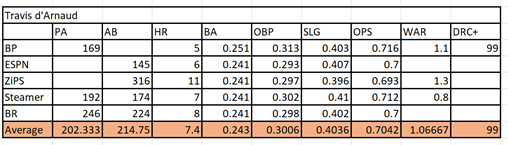
Every spring at 213 we gather a whole bunch of projections for players and average them together to see what a conglomerate of baseball sources think a given player will perform over the year. It’s wholly unscientific – averaging averages and not weighting them for previous accuracy or amount of playing time they feel a player will see.

Travis d’Arnaud is the last one! It’s fitting last year that we started with a player the captured so much of how the Mets operated last year. Before Spring Training, the Mets picked d’Arnaud over Kevin Plawecki, despite health concerns. Then at the start of the season, the Mets picked d’Arnaud over Devin Mesoraco, despite health concerns. Then they rushed d’Arnaud back, he struggled, he somehow ended up on the Dodgers, then quickly ended up on the Rays and put together one of his better seasons in baseball and signed a lucrative deal with the Braves in the off-season. The whole episode felt very Mets like. Last year we tried to figure out where he fell in the Mets depth chart while sharing these projections:

2019 Mets Stats: 25 PA, 23 AB, 0 HR, .087/.154/.083, .237 OPS, -0.3 WAR, 70 DRC+
2019 Rays Stats: 365 PA, 327 AB, 16 HR, .263/.323/.459, .782 OPS, 1.4 WAR, 104 DRC+

As soon as Travis got out of the Mets system, he blossomed into the type of player that we always thought we could be. He turned in such a good season that no singular projection came close to it. The only you could argue that might have had an idea was Baseball Prospectus, but thats only when you add the time with the Mets into the time with the Rays and even then Travis is still performing better than the projections.

If you are down on yourself with how the Mets handled the Travis situation, just remember this – you’re not a Blue Jays fan (probably, if you’re reading this website). This year d’Arnaud finally showed us what he can do and we’ve known for years what Syndergaard could do.

Posted in Main Page | Leave a comment

2019 Mets Projections Review: Tomas Nido

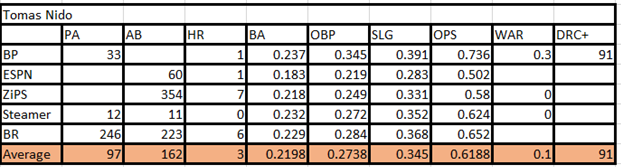
Every spring at 213 we gather a whole bunch of projections for players and average them together to see what a conglomerate of baseball sources think a given player will perform over the year. It’s wholly unscientific – averaging averages and not weighting them for previous accuracy or amount of playing time they feel a player will see.

We are almost at the end of this article series! It’s our second to last post! When we wrote this article last year, we were struggling to see where Tomas Nido stood with the team. At the time the Mets had Wilson Ramos and decided to keep d’Arnaud over Plawecki. Plus the Mets gave a Spring Training invite to Devin Mesoraco. Of course, the Mets are the Mets and Nido saw action in 50 games last year.

His projections (below) weren’t pretty but we also weren’t expecting them to be:

2019 Stats: 144 PA, 136 AB, 4 HR, .191/.231/.316, .547 OPS, -0.7 WAR, 58 DRC+

So Nido had a rough year last year. He didn’t even make his projections, and his projections at .618 OPS were already pretty rough. Out of all of the hitters who saw more than a cup of coffee last year that we did projections reviews for, his DRC+ is the worst.

I guess ZiPS was the closest on him in terms of a slash line, the rest of the projections tried to predict playing time and saw so little that their slash lines don’t make sense.

Overall, this highlights the need the Mets have right now at looking for a back up catcher.

Posted in Main Page | Leave a comment

2019 Mets Projections Review: Wilson Ramos

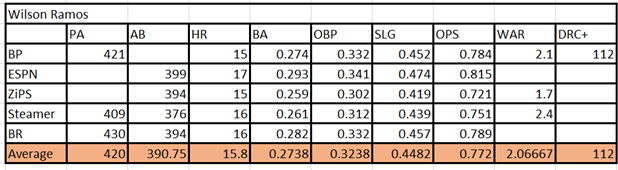
Every spring at 213 we gather a whole bunch of projections for players and average them together to see what a conglomerate of baseball sources think a given player will perform over the year. It’s wholly unscientific – averaging averages and not weighting them for previous accuracy or amount of playing time they feel a player will see.

Our projections review series is starting to wind down as we cross into the last category of players – catchers! Wilson Ramos was signed to a team friendly deal. He was coming off a 2.7 WAR, 121 DRC+ season. Last year we were excited about the upgrade he provided behind the plate and we were even more excited by his projections (compared to the other catchers on the roster in 2018):

2019 Stats: 524 PA, 473 AB, 14 HR, .288/.351/.416, .768 OPS, 2.0 WAR, 100 DRC+

Ramos last year hit a bit more average and got on base a lot more than his projections originally thought he would while his power saw a bit of a drop. For the most part he had a successful year and as the season went on, became a quite, consistent part of the Mets (as the Mets got surprise power from a few other players last year and didn’t need all of Ramos’ projected power). I think an interesting note though is from the Baseball Prospectus line, who was off projection exactly like the first line of this paragraph said, thus undercutting his OPS a bit. They projected him to hit 12% better than the average hitter last year but in reality Ramos was exactly the average hitter last year.

Which is what Mesoraco represented on the 2018 Mets.

I know this seems like I’m saying Mesoraco and Ramos are the exact same player. I’m not. You can’t compare DRC+ from different players across different years. I think this is a larger note about the direction hitting last year took and what it means to be the league average hitter changed.

Posted in Main Page | Leave a comment

2019 Mets Projections Review: Robinson Canó

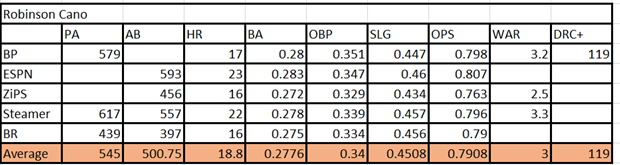
Every spring at 213 we gather a whole bunch of projections for players and average them together to see what a conglomerate of baseball sources think a given player will perform over the year. It’s wholly unscientific – averaging averages and not weighting them for previous accuracy or amount of playing time they feel a player will see.

Heading into the last season, Robinson Canó (and Edwin Diaz) were two of the most important acquisitions on the Mets. BVW gave up a lot for them in trade, both in future players and future financial flexibility. The prevailing feeling around Canó was that the Mets would have 2-3 seasons before his contract becomes an albatross. Last year, I felt good about his projections, lets see how that feeling panned out:

2019 Stats: 423 PA, 390 AB, 13 HR, .256/.307/.428, .736 OPS, 0.3 WAR, 89 DRC+

Last year was rough for Canó. He was lost at the plate for about half a year and when he finally started to heat up and turn the ship around, he got injured and lost an entire month of the season. It’s part of the reason why we see such a huge dip in his DRC+ In 2018 he was better than 25% of the average hitter, he was projected to be better than 19% of the average hitter. He ended up being 11% worse than the average hitter. He hasn’t performed like that since 2008.

The projections were also all pretty much in lock step with what Canó would produce so it comes really as a massive surprise all around that he performed the way that he did. Really only cynical Mets fans can claim that they projected he was going to under perform by that much.

So heading into 2020 – Canó can only improve, I expect the computers to project a bit down from what they did last year but by not a crazy amount, and I expect the bulk (or the loudest) Mets fans at the stadium to be unfairly tough on Canó at the start of the season.

Posted in Main Page | Leave a comment