
During the Mets broadcast last Saturday, the booth got into a discussion about rising fastballs where they jokingly said to put Physicists in the batters box and have them tell you that fastball doesn't rise. This is in reference to how baseball players always quote that fastballs can rise and where Physicists explain that a pitcher cannot apply enough backspin to a fastball to get the pitch to literally rise.
Why do some fastballs appear to rise? Being a physicist* in training, I feel comfortable stating that fastballs do not actually rise.
In order understand this statement we have to first remember a very important point, one that is focused on by Professor Robert K. Adair, Sterling Professor Emeritus of Physics at Yale (elementary particles and forces of nature), and also the author of The Physics of Baseball. No matter what any observer believes they see at a game (baseball player, fans, announcer) a player can never actually throw the ball flat. Even a strong arm throw across the diamond, has some curve (as in curve up and down) to it because of forces that act on baseball. This curvature though can be seen as flat because over short distances, it appears flat (similar to how the Earth can appear to be flat).
A fastball can have a very noticeable drop to it. However, because of a psychological frame of reference, one that does not have a lot of drop is referred to as flat. These balls that are “flat” actually are dropping but baseball hitters, see a lot of fastballs, and that in their minds might as well be flat, the zero line if you will. A pitch without a lot of drop appears to be zero, everything else, mainly breaking balls, are then negative.
Fastballs can be thrown with backspin. This backspin, which Adair says can usually be around 1200 to 1800 rpm (rotations per minute), allows the fastball to not drop as much as it would normally. The batter then see's this fastball above his “zero line”. To the batter, the fastball now has a positive drop or has actually risen. But that “zero line” is just a mental construct, it still is dropping, just dropping less than the average fastball. In a game of centimeters and milliseconds, this slight difference in drop can make a major difference.
To drive this point home, take a look at this image:
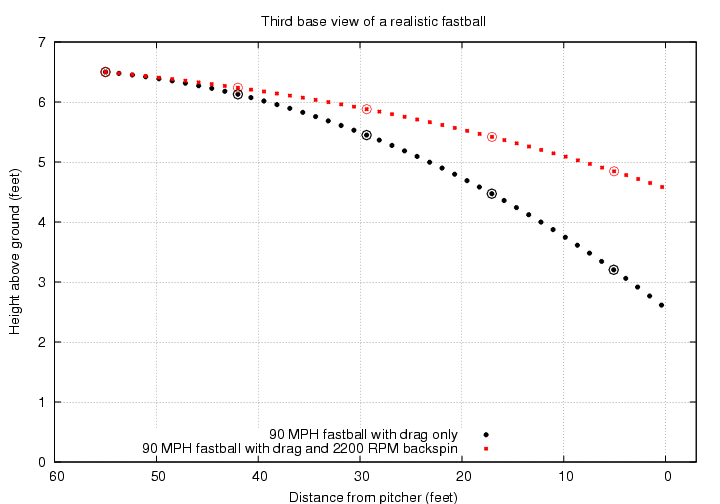
(From Michael Richmond, RIT)
It also key to note about rising fastballs that there are some fastballs that do actually rise. I know I said earlier that they don't, but there is a situation where they do in fact rise. If a pitcher is throwing side arm or lower, than the pitcher has to throw the ball up. In that case, the ball does actually rise. However, in the normal sense, most pitchers are only throwing down and these are pitchers that are usually referred as having “rising fastballs”. Side-armers rising fastballs do not have the same affect as fake rising fastballs, because the batter knows that the trajectory of the ball from a side-armer will be up and then down, or just up.
*I am currently a Junior Physics and Astrophysics double major at the University of Maryland.


