2019 Mets Projections Review: Tomas Nido

Every spring at 213 we gather a whole bunch of projections for players and average them together to see what a conglomerate of baseball sources think a given player will perform over the year. It’s wholly unscientific – averaging averages and not weighting them for previous accuracy or amount of playing time they feel a player will see.

We are almost at the end of this article series! It’s our second to last post! When we wrote this article last year, we were struggling to see where Tomas Nido stood with the team. At the time the Mets had Wilson Ramos and decided to keep d’Arnaud over Plawecki. Plus the Mets gave a Spring Training invite to Devin Mesoraco. Of course, the Mets are the Mets and Nido saw action in 50 games last year.

His projections (below) weren’t pretty but we also weren’t expecting them to be:
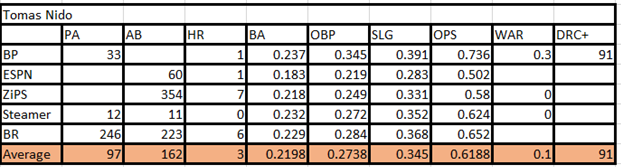
2019 Stats: 144 PA, 136 AB, 4 HR, .191/.231/.316, .547 OPS, -0.7 WAR, 58 DRC+

So Nido had a rough year last year. He didn’t even make his projections, and his projections at .618 OPS were already pretty rough. Out of all of the hitters who saw more than a cup of coffee last year that we did projections reviews for, his DRC+ is the worst.

I guess ZiPS was the closest on him in terms of a slash line, the rest of the projections tried to predict playing time and saw so little that their slash lines don’t make sense.

Overall, this highlights the need the Mets have right now at looking for a back up catcher.

Posted in Main Page | Leave a comment

2019 Mets Projections Review: Wilson Ramos

Every spring at 213 we gather a whole bunch of projections for players and average them together to see what a conglomerate of baseball sources think a given player will perform over the year. It’s wholly unscientific – averaging averages and not weighting them for previous accuracy or amount of playing time they feel a player will see.

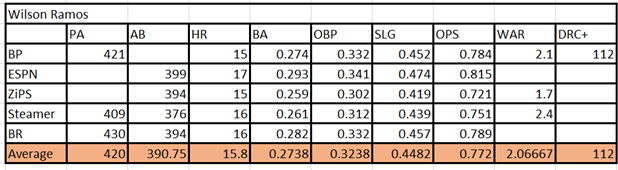
Our projections review series is starting to wind down as we cross into the last category of players – catchers! Wilson Ramos was signed to a team friendly deal. He was coming off a 2.7 WAR, 121 DRC+ season. Last year we were excited about the upgrade he provided behind the plate and we were even more excited by his projections (compared to the other catchers on the roster in 2018):

2019 Stats: 524 PA, 473 AB, 14 HR, .288/.351/.416, .768 OPS, 2.0 WAR, 100 DRC+

Ramos last year hit a bit more average and got on base a lot more than his projections originally thought he would while his power saw a bit of a drop. For the most part he had a successful year and as the season went on, became a quite, consistent part of the Mets (as the Mets got surprise power from a few other players last year and didn’t need all of Ramos’ projected power). I think an interesting note though is from the Baseball Prospectus line, who was off projection exactly like the first line of this paragraph said, thus undercutting his OPS a bit. They projected him to hit 12% better than the average hitter last year but in reality Ramos was exactly the average hitter last year.

Which is what Mesoraco represented on the 2018 Mets.

I know this seems like I’m saying Mesoraco and Ramos are the exact same player. I’m not. You can’t compare DRC+ from different players across different years. I think this is a larger note about the direction hitting last year took and what it means to be the league average hitter changed.

Posted in Main Page | Leave a comment

2019 Mets Projections Review: Robinson Canó

Every spring at 213 we gather a whole bunch of projections for players and average them together to see what a conglomerate of baseball sources think a given player will perform over the year. It’s wholly unscientific – averaging averages and not weighting them for previous accuracy or amount of playing time they feel a player will see.

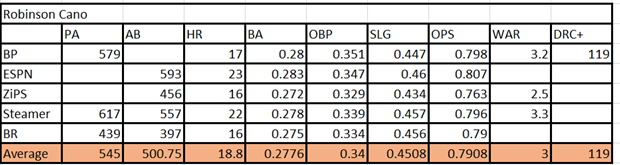
Heading into the last season, Robinson Canó (and Edwin Diaz) were two of the most important acquisitions on the Mets. BVW gave up a lot for them in trade, both in future players and future financial flexibility. The prevailing feeling around Canó was that the Mets would have 2-3 seasons before his contract becomes an albatross. Last year, I felt good about his projections, lets see how that feeling panned out:

2019 Stats: 423 PA, 390 AB, 13 HR, .256/.307/.428, .736 OPS, 0.3 WAR, 89 DRC+

Last year was rough for Canó. He was lost at the plate for about half a year and when he finally started to heat up and turn the ship around, he got injured and lost an entire month of the season. It’s part of the reason why we see such a huge dip in his DRC+ In 2018 he was better than 25% of the average hitter, he was projected to be better than 19% of the average hitter. He ended up being 11% worse than the average hitter. He hasn’t performed like that since 2008.

The projections were also all pretty much in lock step with what Canó would produce so it comes really as a massive surprise all around that he performed the way that he did. Really only cynical Mets fans can claim that they projected he was going to under perform by that much.

So heading into 2020 – Canó can only improve, I expect the computers to project a bit down from what they did last year but by not a crazy amount, and I expect the bulk (or the loudest) Mets fans at the stadium to be unfairly tough on Canó at the start of the season.

Posted in Main Page | Leave a comment

2019 Mets Projections Review: J.D. Davis

Every spring at 213 we gather a whole bunch of projections for players and average them together to see what a conglomerate of baseball sources think a given player will perform over the year. It’s wholly unscientific – averaging averages and not weighting them for previous accuracy or amount of playing time they feel a player will see.

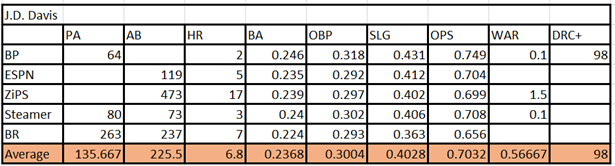
Before we even get into reviewing his 2019 projections, when looking back on what we wrote about J.D. Davis last year – oh boy. We were so down on him, and were proved so wrong by the end of the season. We were frustrated because we liked Luis Santana and Ross Adolph as prospects. Then with the Lowrie signing, trading for J.D. Davis seemed redundant. But Lowrie only got to the plate 9 times so it was as if we never signed J.D. in the first place. We did talk about how J.D.’s minors numbers were fantastic (.292/.362/.521) before looking into what computers projected for his 2019 season:

2019 Stats: 453 PA, 410 AB, 22 HR, .307/.369/.527, .895 OPS, 1.0 WAR, 122 DRC+

Holding ZiPS aside, which doesn’t have the same playing time calculation as the rest of them, the projections struggled with finding Davis time in the field which makes sense on a team that was struggling to find Jeff McNeil playing time before the season started thanks to the odd off-season the Mets had leading into 2019. Davis got an opportunity and ran with it, hitting 70 points higher, getting on base 70 points higher and slugging around 120 points higher than his projected totals. Baseball Prospectus had him right around league average for a hitter and he ended up 22% better than average.

BVW failed in a lot of different ways last year, but this wasn’t one of them. The Davis trade was an absolute steal for the Mets. He has a similar problem going into this season, where he doesn’t quite have a position and the Mets still may trade him to upgrade somewhere else.

If that doesn’t happen, it will be interesting to see how computers adjust in their 2020 projections.

Posted in Main Page | Leave a comment

2019 Mets Projections Review: Todd Frazier

Every spring at 213 we gather a whole bunch of projections for players and average them together to see what a conglomerate of baseball sources think a given player will perform over the year. It’s wholly unscientific – averaging averages and not weighting them for previous accuracy or amount of playing time they feel a player will see.

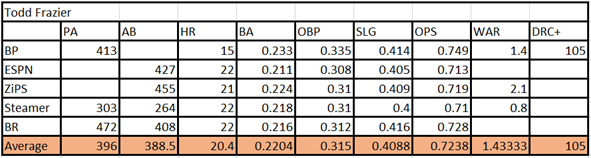
Todd Frazier, who recently signed with the Rangers, had an interesting year in retrospective with the Mets. Going into the season he was seen as a super utility player, filling in gaps for Lowrie, giving Alonso a day off (he was also part of the calculus to maybe start Alonso in the minors). Of course, this would have depended on everyone’s health, and that didn’t pan out for Lowrie. Frazier had strong moments on the field for the team but off the field he started blocking/attacking fans on Twitter, making it more difficult to root for him. Last year we said if the Mets make the playoffs, it could all be because of Todd Frazier. Let’s look at his projections and what he actually did:

2019 Stats: 499 PA, 21 HR, .251/.329/.443, .772 OPS, 2.2 WAR, 104 DRC+

Frazier was coming off a year that saw a huge drop in OBP (.303 in 2018) which was his lowest since 2016 (.302). I’m assuming that, plus his age, had models effectively project slightly below his career line in OBP, and significantly below his career line in slugging.

But Todd played well last year. He got on base a lot more effectively than he did before, he hit for a lot more power than he did before, etc. The closest projection for him was Baseball Prospectus who appeared as an outlier in the table. This is a significant victory for them and maybe one of the more stark victories for the projection on the Mets last year. Interesting to note, despite being the most bullish on Todd and being right about that, they still projected him only 5% better than the average hitter, and he ended up being only 4% better. This speaks to why the Mets didn’t extend a contract to him. He’s a solid player but the Mets have a lot of solid players with more upside at that position (J.D. Davis) even if defense is a question. We hope he has another solid year down in Texas.

Posted in Main Page | Leave a comment

2019 Mets Projection Review: Luis Guillorme

Every spring at 213 we gather a whole bunch of projections for players and average them together to see what a conglomerate of baseball sources think a given player will perform over the year. It’s wholly unscientific – averaging averages and not weighting them for previous accuracy or amount of playing time they feel a player will see.

Last year we opened up our Luis Guillorme projection article talking about how incomprehensible his playing time was. Luis, a defensive star, saw his time taken away by Jose Reyes, an owner favorite. We also talked about how difficult it was going to be for him to get playing time in 2020 due to the amount of players the Mets had in the infield (Todd Frazier, Robinson Cano, Amed Rosario, Dominic Smith, Pete Alonso, Jeff McNeil, Jed Lowrie) and even with injuries to pretty much everyone who played third, Luis still saw not enough playing time in 2020. What follows are his projections and his actual numbers:

2019 Stats: 70 PA, 61 AB, 1 HR, .246/.324/.361, .684 OPS, 0.1 WAR, 85 DRC+

Baseball Prospectus was on it this year for Slugging, Batting Average, OPS (although Baseball Reference was close to that as well) and DRC+. Ultimately Luis played pretty much to his projections and the computer programs handled him appropriately, except for playing time. I imagine that in 2020 we’ll see a similar situation where the slash line stats for Luis look correct to what he actually does but the programs will struggle to accurately predict his playing time. That’s probably because Mets pundits will also struggle with predicting how much time he has with the big league club.

Ultimately at 213 we want to see more of Luis in 2020, we are hoping this is the year where he can establish more of a bench role with the big league club.

Posted in Main Page | Leave a comment

2019 Mets Projections Review: Jed Lowrie

Every spring at 213 we gather a whole bunch of projections for players and average them together to see what a conglomerate of baseball sources think a given player will perform over the year. It’s wholly unscientific – averaging averages and not weighting them for previous accuracy or amount of playing time they feel a player will see.

I’ve not been anxiously awaiting Jed Lowrie‘s review article in this series. The Mets signed Lowrie to a 2-year deal before last season for 20 million and he barely played last year, fighting injuries pretty much the entire season. Furthermore, from the beginning he was a superfluous signing as the Mets were already flushed with corner infielders. But the Mets signed him and were stuck with him. Last year when we wrote his projections article we were wondering how the Mets were going to split time between him and Frazier. The computers thought he would get most of the playing time with these projections:

2019 Stats: 8 PA, 7 AB, 0 H, BB, .000/.125/.000, .125 OPS, -0.2 WAR, 71 DRC+

So Jed essentially didn’t play last season until the Mets forced him to play in September, sort of. It would have been nice to see his projected .746 OPS on the field last year and 15 homers would have been nice as well. There’s no way to tell from his playing time if the projections failed for Jed.

Now what about 2020? Do the projections this year really tamper down? Do they project more to the mean (probably). Is Lowrie still on the team by the time Spring Training starts (maybe?). Was this article worth writing (probably not)?

Posted in Main Page | Leave a comment

2019 Mets Projections Review: Jeff McNeil

Every spring at 213 we gather a whole bunch of projections for players and average them together to see what a conglomerate of baseball sources think a given player will perform over the year. It’s wholly unscientific – averaging averages and not weighting them for previous accuracy or amount of playing time they feel a player will see.

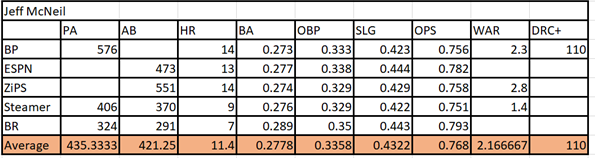
Last year we opened up talking about how Mets it was to hold off Jeff McNeil‘s call up in 2018 because they wanted him to play second while the plan in 2019 became for him to play all over the diamond. Going into the season last year, we were all wondering what was going to happen to the player who slashed .329/.381/.471 in 248 PA’s in his rookie year with a 2.4 WAR and a 119 DRC+. The computer projection outlets had this to say:

2019 Stats: 567 PA, 510 AB, 23 HR, .318/.384/.531, .916 OPS, 5.0 WAR, 129 DRC+

So McNeil crushed it.

McNeil was another case where the computers mostly projected between a .273 and .276 BA, which is quite close together. He instead hit .318 and was one of the Mets best players last year. He performed 29% better than the average hitter, and was projected to be only 10% better. Basically he came to the plate with his same, if not better, ability to put the ball in play and get on base except he also hit homers.

So he smashed projections. I’m sure next month when we start 2020 projections we’ll see outlets try to low ball again, I’m guessing this time they won’t low ball him by so much.

Posted in Main Page | Leave a comment

2019 Mets Projections Review: TJ Rivera

Every spring at 213 we gather a whole bunch of projections for players and average them together to see what a conglomerate of baseball sources think a given player will perform over the year. It’s wholly unscientific – averaging averages and not weighting them for previous accuracy or amount of playing time they feel a player will see.

You know what feels like forever ago? T.J. Rivera on the Mets. But he was on the Mets last year! He became a fan favorite essentially instantly, had a great 2017 and then injuries kept him away from the field much of 2019, until the Mets cut him and then he started playing independent ball. Last year we wrote about how his health, J.D. Davis and Gavin Cecchini were all in his way from getting a roster spot. Despite all that, many outlets still wrote projections for him:

Ultimately, Rivera was released about a week after we wrote the preview article for him last year. After playing in independent ball he was picked up by the Nationals but never saw any major league playing time with them and was released in November. He’s still a free agent.

Rivera hit .304/.335/.445 in 344 PA’s for the Mets across 2016 and 2017. It’s a shame that so many things prevented him for getting on the field again. We appreciate the memories with him, and although it doesn’t feel like the Mets have any room for him, we wouldn’t be against the Mets signing him to a minor league contract.

Posted in Main Page | 1 Comment

2019 Mets Projections Review: Amed Rosario

Every spring at 213 we gather a whole bunch of projections for players and average them together to see what a conglomerate of baseball sources think a given player will perform over the year. It’s wholly unscientific – averaging averages and not weighting them for previous accuracy or amount of playing time they feel a player will see.

Before the season last year, we wrote about how Amed Rosario ended 2018 strong, hitting .303/.335/.444 from August 10th on. Defensively in 2019, his season was similar – struggling so much at the start of the season that there was a rumor that the Mets were going to put him in Center by the end of the season, and then he turned things around. Projections before 2019 took his 2018 tale of two seasons and produced the following lines:

2019 Stats: 655 PA, 616 AB, 15 HR, .287/.323/.432, .755 OPS, 1.8 WAR, 96 DRC+

Amed Rosario outperformed what everyone was thinking with the bat. In every category except WAR. That’s fantastic for him and even more amazing for us! Interestingly, the projection programs were fairly grouped together on Rosario. All of them, except ESPN, had him getting on base at about a .300 clip (and ESPN, which usually over projects, under projected everyone).

What we’ll look for in 2020 is first, are the computers super aligned on a result again? Second, do they project Rosario at his 2019 numbers, above his 2019 numbers (breakout?) or below them, suggesting that there is some mean for Rosario to regress too. Only because I’ve done a bunch of these articles over the last couple of years, my gut tells me that projections will show a regression to some career line, despite Rosario only playing for parts of 3 seasons. Generally when the algorithms are this aligned, there’s something that they are seeing in the player. If that happens, I also feel that Rosario will out perform them again.

Posted in Main Page | Leave a comment